D.T. Foco and Associates owner David Foco said dealerships seeking to improve their parts departments need to improve their communication.
Foco said effective communication between departments, especially the service and parts departments, can be the difference between profits and losses.
He said daily status meetings between teams/departments give employees a fuller picture of the dealership.
“Most of the time I get ‘Well, Dave, we are too busy to have this meeting,’” Foco said. “We are too busy because we are not having this meeting. You do not have time for it because you are too busy scattered all over the place, because we do not have a playbook in place, and we do not have a game plan in place for each and every single day.”
Foco said understanding how a team member does their job can affect how other team members do theirs. He said employees should have the same goal: to take care of internal & external consumers and the store’s inventory.
Internal customers are the dealership employees such as the service department and sales department that need parts to take care of customers’ RVs. External customers visit the store simply to purchase a part, buy an RV or get their RV serviced.
“Both groups need to be treated equally,” Foco said, “with the same professional enthusiasm and respect and time and appreciation.”
He said inventory balance is another trademark of a good parts department.
“Obsolete parts can kill parts departments,” Foco said. “Once that hits 90 days, the chances of us selling or moving that part is going to be reduced substantially. Sometimes we lose sight on exactly what our expense is when we are carrying the type of parts and accessories that we are carrying such as initial costs, freights and carting interest costs.”
Foco told an RVDA Convention audience that 50% of parts that sit on the shelf for six months will not sell in the next six months. He said 85% of parts that sit for nine months will not sell in the next three.
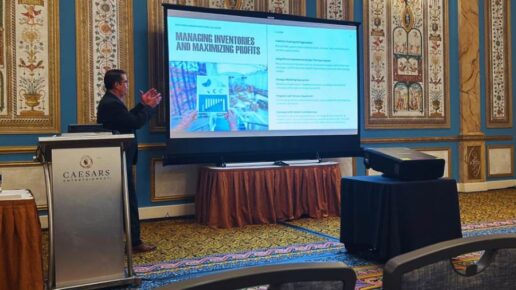
The key, Foco said, is balancing parts in stock needed to reduce repair event cycle times (RECT) as well as monitoring the special-order parts inventory report for parts scheduled for installation.
He said dealers often carry multiple manufacturers, with multiple RV makes and models. He said carrying every bolt, nut, screw, or part needed for all RVs in stock is not an effective parts strategy as well as impossible due to space and storage limitations.
Foco said parts department managers’ other focus areas include using the dealer management system’s full capabilities, performing detailed inventory checks, inspecting parts upon arrival and protecting against fraud.
Using a DMS’ tools to track quick-moving parts sitting on the shelf can improve RECT.
He said, “By utilizing these reports…we are going to be very calculated as to what we hold in inventory.”
Foco said dealerships should track their parts from the time they are ordered until they are sold and/or installed.
He highlighted the use of a special-order parts route sheet that helps communication between departments regarding dealership parts ETAs and enables better customer follow-up and scheduling.
“I do not care if that crate looks good,” Foco said. “I do not care if that box looks good. Open it up and make sure it is what it is supposed to be and it is not damaged.”
By putting a little more effort into these parts department areas and fostering a culture of communication and teamwork, Foco said dealerships can reshape how they sell parts and increase profitability.