The legendary basketball coach’s face is a murderous shade of red as he screams and spits, inches from a referee’s face.
Two seconds remain in the game. The official called a foul. The legendary coach’s team is facing elimination.
The coach focuses his wrath squarely on the official. The official remains calm.
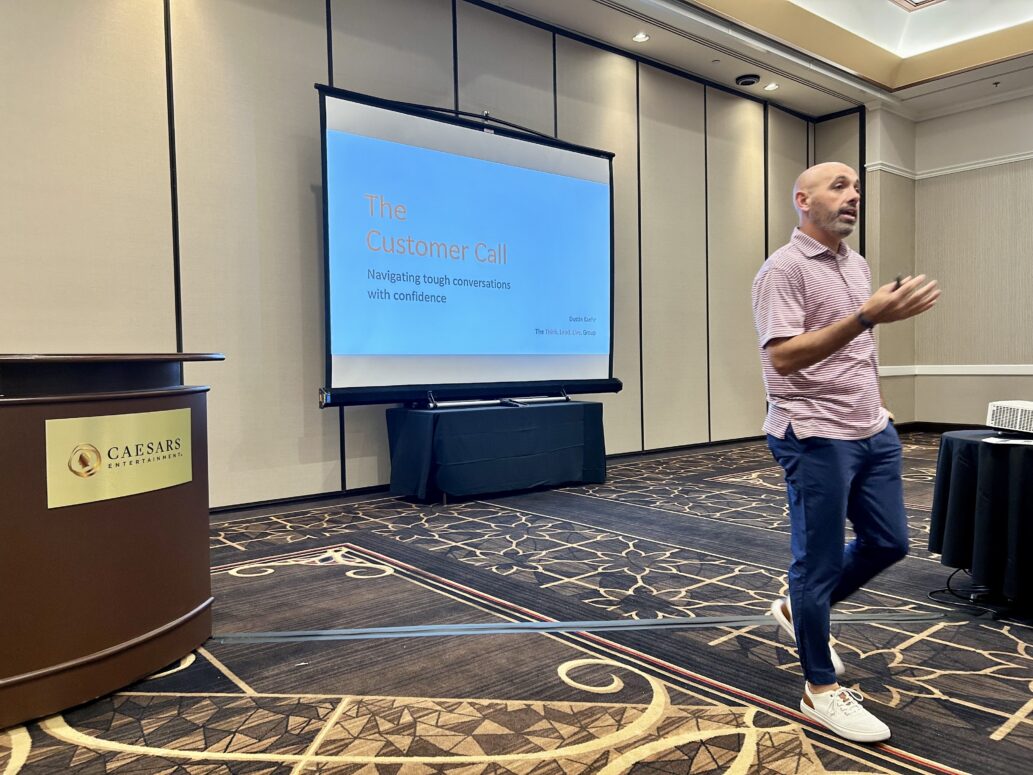
The situation is familiar to Dustin Kaehr, a former college basketball official and Lippert’s former director of leadership development. Kaehr recently spoke about engaging in constructive communication with customers and coworkers during conflict.
“I tell people I have a bachelor’s degree in psychology and an MBA, and I use the psych degree much more than the business degree,” Kaehr said, “because every issue is a people issue.”
In situations of miscommunication and conflict, Kaehr provided three steps for employees to consider before they lose their cool, and possibly their job: absorb chaos, create calm and provide hope.
Kaehr said absorbing chaos means handling someone emotional and chaotic without letting their emotions affect employees’ state of mind.
Kaehr’s second step is to create calm by controlling body language and non-verbal communication.
“Think of your favorite war movie,” Kaehr said at the RVDA Convention/Expo. “Think of the most intense battle scene in that war movie and then think of the leader on that battlefield. Are they absolutely in control? Are they commanding? Do they have presence? Yes. Are they running around like their hair is on fire? No.”
Kaehr said relaying a sense of calm back to the person communicating is crucial to avoid escalating the conflict.
Kaehr’s final part is to provide hope. Once employees absorbed the initial emotion and lowered the intensity, he said they should provide hope that the issue will be addressed.
He said two reasonable, equally informed people disagreeing is easy and can lead to a breakdown in communication. He said the situation is like a conversation in which the two parties seem to be speaking different languages.
He said the communication breakdown is derived from each person’s perspective. He said the perspective can lead three different people to hear three different things from the same conversation.
“Perception is reality,” Kaehr said. “The part of your brain that handles your perception sits really, really close to the part of your brain that handles your imagination. It is why scary movies work. Your imagination becomes your perception, and that becomes your reality.”
Conflict can also take the form of debates between parents over whose child is at fault in a scuffle. Conflict can arise from conversations with coworkers about which department is at fault for a dealership’s issues.
“The best teams handle conflict well,” Kaehr said. “It is one way to pull culture forward, because it is a combination of operational excellence and relational health.”