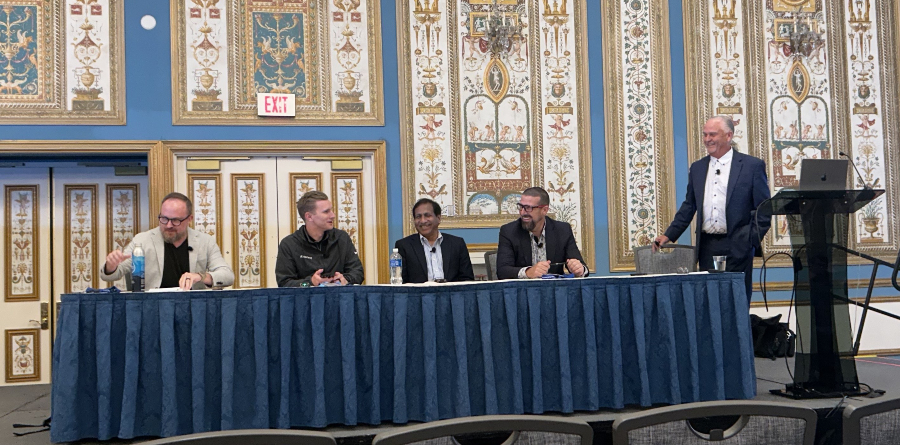
A group of industry experts recently discussed Artificial Intelligence’s (AI) use in the RV industry. Wheeler Advertising founder and President Ron Wheeler led the panel.
“Since I have been around a lot, I have seen a lot of changes,” Wheeler said, “and certainly this next change we are living in right now is AI.”
Wheeler said the development of new technology in the RV industry is nothing new. He said dealers’ feelings about AI are probably similar to what they were feeling at the onset of the internet and online listings.
“With that comes a couple of feelings, where we are excited, but we are also scared,” Wheeler said. “We are reacting to a perceived threat. It is a threat I think is important to all of us. We have got to be really careful about that threat, and it is this threat called FOMO, or fear of missing out.”
Wheeler warned that FOMO can cause dealers to make hasty, often flawed decisions about technology.
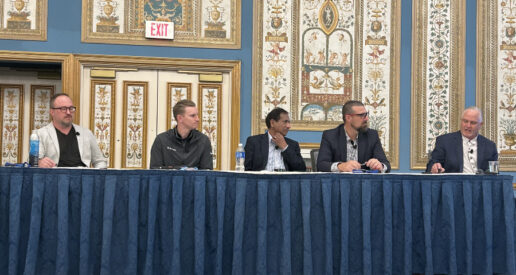
The panel, gathered at the RVDA Convention/Expo, consisted of four members of the RV and AI communities: iA Dealer Services Head of Learning and Development Mark Goldsmith, Rapidious founder and CEO Kishore Rajgopal, Kenect co-founder and Chief Revenue Officer Graham Anderson and LAHZO founder and CEO Brad Shepard.
LAHZO is an AI-powered growth strategies company. Rapidious is an AI-driven SaaS platform. iA Dealer Services is an insurance and warranty provider. Kenect is an AI communication and reputation management platform.
Wheeler said the panel’s goal was to discuss practical AI applications in inventory, sales, F&I services and marketing.
“When you see that AI is being used on inventory and sales, you can see that you are running your dealerships more effectively, more efficiently,” Rajgopal said. “You figure out opportunities for pricing. What are the units in your stock pricing at? Which ones are priced higher? How do you know? How do you know they are priced higher, compared to nationwide…compared to, you know, a 5-mile radius?”
Shepard said dealerships using AI are more efficient with inventory and closing more sales.
“Today, the dealerships that have wholly implemented fully autonomous agentic AI sales are seeing 20% to 40% higher sales conversion closing,” Shepard said. “When I think about tomorrow, I really think it is more about how predictable can we make revenue as AI becomes implemented more throughout the whole organization. I think we are in the early stages of that.”
Anderson said service departments are an example of how AI is saving skilled workers time by doing menial and repetitive tasks.
“A lot of what is available to you now with AI are things that can be replaced by a machine,” Anderson said. “The things that take a bunch of time but are not of great value, things like just the basics of scheduling a service appointment, sending appointment reminders or status updates, some of those basic things that are hard for somebody to manually be doing all day.”
 Incoming phone calls are another major pain point the panel said AI can relieve.
“Think about just your inbound phone calls in your service department,” Anderson said. “What are the primary topics that are happening? Is my RV ready for pickup? Can I schedule a time to bring my RV?” Both of those conversations, for the most part, can now actually be handled by an AI solution.”
Another potential AI use is to make marketing more engaging while connecting it directly with sales. Shepard said fully autonomous AI Sales Agents can send out a mass text message, handle a full back-and-forth conversation and schedule a sales appointment.
Goldsmith said AI is affecting F&I services in two main ways. He said AI can help dealers communicate which programs they offer in a style consumers prefer. He said AI can also aid dealers’ training and development.
Goldsmith said a dealer could upload all its training materials into an AI-powered program, which would then create unique training scenarios for trainees.
All the panelists said any business technology has to save dealers time, make dealers money or make dealers’ lives easier.
They agreed that AI can do all three when used correctly.
The group agreed that the two big mistakes dealers can make with AI are either ignoring AI or moving too quickly and paying too much for a service.
“If your brother’s uncle has a friend that is making an AI solution with a team in India, I want you to not take that phone call,” Wheeler said. “I will trust the ones that actually have a customer base, have a track record.”
The panel also warned attendees that an AI platform that does not work is not the worst-case scenario. They said a dealer’s nightmare is an AI chatbot giving out incorrect information.
Anderson and Goldsmith said dealers need to start seeking AI solutions today.
“Do not delay,” Anderson said. “This is not the future anymore. It is the present. Go get started.”