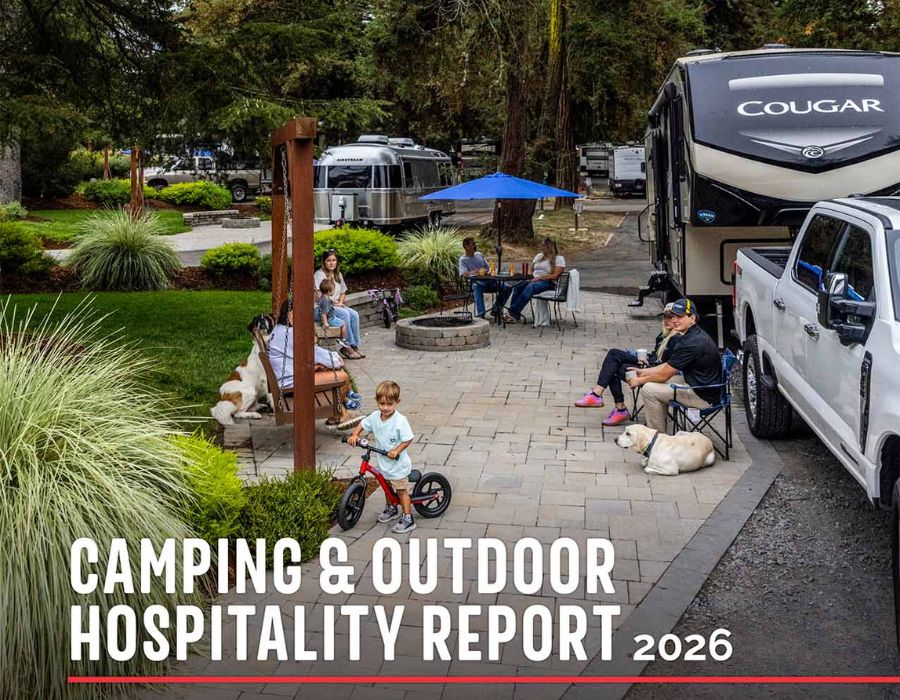
The number of U.S. and Canadian camping households held steady in 2025, while remaining above pre-pandemic benchmarks, according to KOA’s 2025 Camping & Outdoor Hospitality Report.
The report indicates consumers who camp are highly engaged and camping in more diverse ways, in more diverse places. The result is a wider audience for the outdoor and hospitality industries.
A few recent travel trends that have expanded the camping demographic include glamping, pet-friendly travel and health restoration. The report said these activities open camping to consumers who might otherwise not be interested.
MENTAL HEALTH
The report indicates physical and mental health have become primary drivers of camping trips.
“More than just a byproduct of time away, mental restoration is now one of the core reasons people choose to camp,” the report states. “They want space to breathe, to move at their own pace and to recharge organically through simply being in nature.”
KOA President and CEO Toby O’Rourke said the report shows nearly half of all consumers who camp (49%) intentionally book trips to improve mental well-being, and 50% prioritize experiences that help them recharge.
“Nature is not a luxury amenity,” O’Rourke said. “It is a real, proven wellness intervention. For hospitality operators, this insight is transformative, positioning the campground experience itself as the product.”
Over three-quarters (77%) of survey respondents said just being in nature is enough, without structured activities or amenities. Three in five (61%) consumers said their top travel goal is to slow down and be in the moment.
The top activities tied to wellbeing while camping include waking near water (52%), wildlife viewing (52%) and viewing the night sky (50%).
Sound, or lack thereof, also affects many consumers who camp.
In all, 61% of millennials, 58% of Gen Z, 56% of Gen X and 49% of baby boomer consumers who camp said they would choose a campground based on its “soundscape.”
It is not just mental health; many consumers who camp are realizing camping’s physical health benefits.
The report states that 81% of consumers who camp notice improvements in sleep, stress and recovery when outdoors. If their health data shows improvement after camping, 67% of travelers said they would camp more.
MAJOR EVENTS IN 2026
This year features a trio of one-off events that KOA said will likely increase travel and camping.
The U.S., Mexico and Canada will host the FIFA World Cup across 16 cities this summer. The report shows that those with higher incomes, millennials, and families with children are the most likely to attend a soccer match.
Just 12% of U.S. respondents said they would be traveling for the World Cup, while 21% of Canadians said they would attend.
The report indicates Americans are more interested in the Route 66 centennial, with 18% reporting they would attend some celebration. The total is three times the number of Canadians who said they would attend.
Over half (55%) who plan to travel for a Route 66 celebration said they will be camping.
Unsurprisingly, only 2% or Canadian campers plan to travel to an America 250 event celebrating 250 years since the signing of the Declaration of Independence. Only 7% of American consumers who camp plan to attend a celebration event over the Fourth of July weekend.
“Excitement will continue to grow for these events as more and more people become aware and begin planning their 2026 trips,” the report states. “Many interested travelers are concerned about high hotel prices and three-quarters of prospective eventgoers would consider other accommodation options like a campground or glamping resort.”
EXPANDED SEASON
The report shows the camping season is expanding. Baby boomers are taking the biggest advantage of this, with 76% of them camping in the shoulder seasons.
June, July and August are the most popular travel months, with 43% of all camping occurring during that time frame. Approximately a quarter (26%) of trips occur in September and October, with 25% in November and December.
Among the top reasons consumers who camp said they avoid the summer months were overcrowded campgrounds (35%), high costs (30%), shoulder season is more fun (29%) and difficulty finding a summer campsite (29%).
GENERATIONAL DATA
The survey found that camping among adults 65 and older reached its highest level in eight years. Consumers aged 65 and older accounted for 22% of all 2025 campers, nearly double the 12% they made up in 2024.
The Baby boomer generation made up 25% of all new campers in 2025, up nearly 10% from 2024.
For the sixth straight year, millennials did the most camping of any generation.
Bringing pets on camping trips has become popular across all generations, with 55% of all consumers who camp bringing their furry friends.
The report shows that 62% of millennials always or sometimes camp with their pets, and 60% of Gen Z consumers who camp with pets say that getting their pet off-leash is essential while camping.