The latest data from the U.S. Department of Commerce’s Bureau of Economic Analysis (BEA) showed record economic output and growth in nearly all sectors of the outdoor recreation economy in 2024.
In total, outdoor recreation contributed $1.257 trillion to gross economic output. The industry employed 5.2 million workers, comprising 3.2% of all U.S. employees. Outdoor recreation provided 2.4% of the nation’s gross domestic product (GDP), totaling $696.7 billion in value-added funds.
The outdoor recreation economy’s gross economic output grew by 3.3% from the $1.216 trillion in 2023 and by 9.6% from the $1.146 trillion in 2022. The industry first topped $1 trillion in gross economic output in 2022. The RV-related company segment remained relatively flat from 2023 ($58.08 billion) to 2024 ($58.11 billion). The segment is still the second-largest among the outdoor recreation segments, trailing only the boating/fishing-related company segment.
RVIA spokesperson Monika Geraci said seeing the RVing segment grow incrementally was not a surprise. She said the growth was similar to the industry’s small but steady wholesale RV shipment growth over the past few years.
“Economic uncertainty and high interest rates have been a hurdle to the industry,” Geraci said, “but there continues to be strong interest in owning an RV, with 16.9 million RV-intender households.”
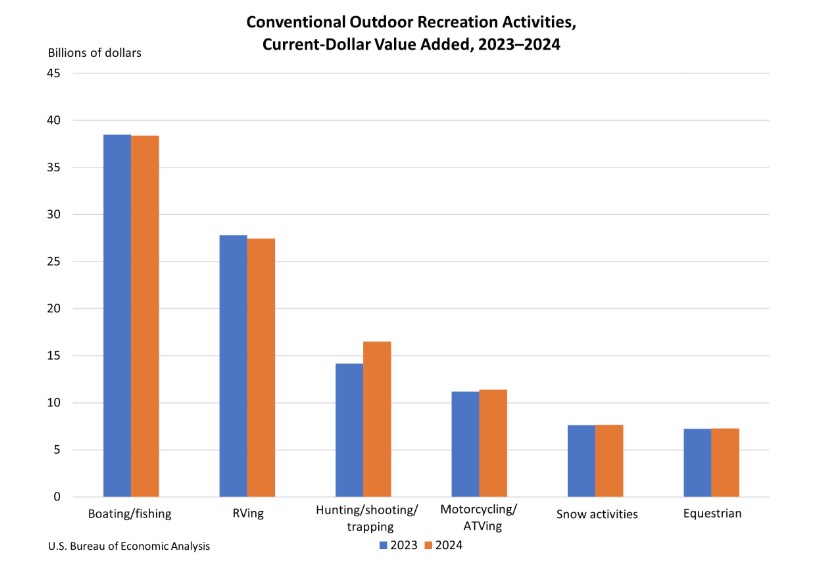
The BEA report found the RV-related company segment contributed $27.45 billion in value-added funds to the national economy. Value-added funds are the BEA’s measurement of GDP. The RV-related company segment was second to the boating/fishing-related company segment, which totaled $38.38 billion in value-added funds.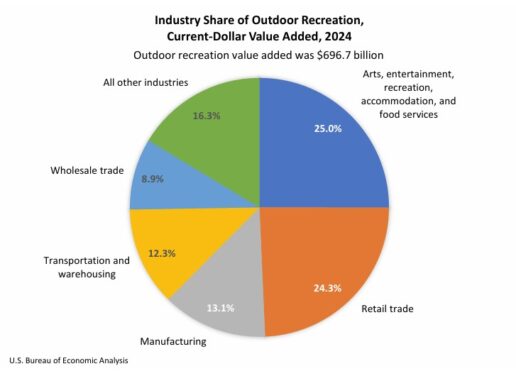
Among the RV-related company segment’s value-added funds, Indiana led all states with $5.166 billion. Texas was second at $2.678 billion, followed by California ($2.094 billion), Florida ($1.627 billion) and Michigan ($901 million). New York, Ohio, Oregon, Pennsylvania and Washington round out the top 10 states by value-added funds.
Since 2012, outdoor recreation has grown 84.2% in actual dollars and 43.3% in dollars adjusted for inflation.
Outdoor Recreation Roundtable President Jessica Turner said, “Today is what we call our industry’s Christmas Day. When we get this BEA data that showcases outdoor recreation’s powerful and positive impact on the U.S. economy.”
The industry’s Christmas was delayed this year. The BEA release typically occurs in November but was delayed over three months by the fall federal government shutdown.
Turner said that although the industry broke records in 2024, the new data reflects macroeconomic hurdles the outdoor recreation economy faces.
“Today’s data announcement really underscores that the outdoor recreation industry remained a huge economic driver, even while growth flattened due to slowing down past the pandemic,” Turner said. “That tracks with headwinds we have all felt, and still feel, from inflation and high interest rates, supply chain, friction and shifting household budgets.”
Outdoor Hospitality Industry (OHI) President and CEO Paul Bambei said private RV parks, campgrounds and glamping businesses serve as gateways to numerous outdoor recreational experiences.
“As more families, younger generations and diverse campers discover the benefits of time spent outdoors, they are also supporting the communities they visit,” Bambei said, “spending an average of $60 per person per day in local communities and helping drive economic growth in destinations across the country.”
Over 110,000 American businesses make up the outdoor recreation economy.
All Trails Head of Brand Engagement Kai Twanmoh said, “We are incredibly bullish about a future where every American gets to experience the benefits of time outside, better personal health and wellbeing, healthier environments, better stewardship of our public lands and waters, and ultimately, greater joy in the outdoor community. That future is enabled by a thriving outdoor economy, and with data like this to guide us, I am confident and excited that we can build it together.”