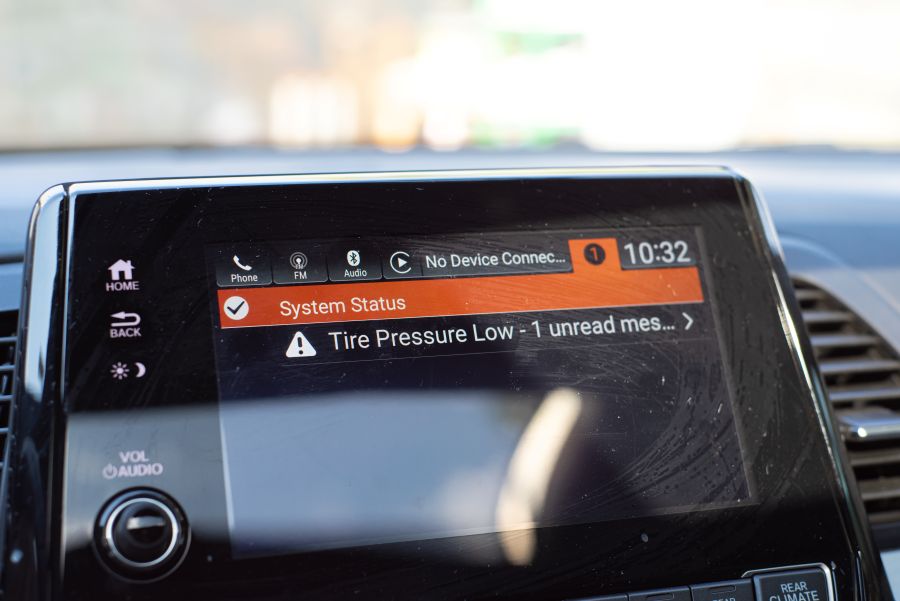
Two decades after tire pressure monitoring systems (TPMS) were required on cars in the U.S., the RV industry will implement the same requirement on 2028 coaches.
RVIA’s Board of Directors approved the motion requiring TPMS installation in March. The Transportation Recall Enhancement, Accountability and Documentation (TREAD) Act of 2000 required the National Highway Traffic Safety Administration to mandate TPMS in motor vehicles weighing under 10,000 pounds. The requirement took effect for all cars made after September 2007.
TPMS as an OE installation is relatively new to the RV industry. Eight years ago, Truck Systems Technologies, now TST by PSI, a Clarience Technologies Co., secured what is believed to be the first OE TPMS deal with Forest River’s Palomino Columbus brand.
TST Vice President of Marketing and Communication Craig Smith said TST long anticipated the RVIA requirement.
“With a proven history in the RV industry dating back to 2009…we are ready to support the industry every step of the way,” Smith said. “We are excited to see RVIA acknowledge the importance of tire pressure and temperature monitoring in helping prevent catastrophic tire failures.”
RVIA Senior Director of PR and Communications Monika Geraci said industry committees tried to get the new requirement into the 2026 National Fire Protection Association (NFPA) 1192 Standard for RVs. SAE International, an organization setting mobility standards for industries around the globe, published a trailer TPMS standard in late October 2024. However, the standard could not be included in the 2026 NFPA 1192 cycle.
“The next revision cycle for the NFPA 1192 Standard has begun for the 2029 edition,” Geraci said. “Because of the work done for the 2026 cycle, the industry has a standard to follow.”
 Geraci said RVIA’s Standards Steering Committee (SSC) recommended moving forward earlier, rather than waiting until publication and enforcement of NFPA’s 2029 edition.
“Many manufacturers are already including TPMS on their units, and TPMS are widely available,” Geraci said. “Safety is of utmost importance, so the SSC felt it was best to implement this requirement now. The RVIA Board of Directors agreed.”
Smith said TST is uniquely positioned to meet increased industry demand for TPMS.
“We are tire people,” Smith said. “Detailed forecasting maps and strong OEM customer communication will be key in making sure we meet the demand as more and more OEMs select their TPMS provider.”
TST’s parent company, Clarience Technologies, is an international company owned by private-equity firm Genstar Capital. Smith said Clarience Technologies is a financially stable company that has access to resources that drive innovation. He said dealing with such a company provides buyers with confidence. TST provides U.S.-based live customer support and a video/resource library.
Smith said Elkhart, Indiana-based TST offers on-site sales and support to its OEM customers.
“TST sales and customer support professionals are part of a larger, integrated team of engineers, field technicians, operations staff, quality control specialists and product developers,” Smith said, “all working together to support our customers.”